Cost: Subscription-based model integrated into Adobe Creative Cloud.
Quality: Offers professional-grade AI-generated videos, animations, and visual effects with seamless integration into Adobe Premiere Pro and After Effects.
Safety: Firefly is trained on Adobe Stock and public domain content, ensuring commercially safe outputs.
Cost: Freemium model with paid tiers for advanced features.
Quality: Offers high-resolution AI-generated videos with advanced editing tools, including lip-syncing and generative audio.
Safety: Implements AI ethics policies to prevent harmful content.
Each platform has unique strengths, whether it’s affordability, professional quality, or ethical safeguards. The evolution in this space is rapid but does not yet replace the need for high quality media content.
Pitfalls
Here’s an example of a generated video that initially appears what I asked for. After a few seconds, the man on the left appears to sneeze and disappears (quite the magic trick!).
Prompt: Create a hot steaming cup of coffee with a colour changing data logo on the outside with a blurred background of an office with robots and humans sitting at desk wearing headsets.
Potential growth of AI and improvements over the next 3 years
Approach to Identify and Prioritise AI Use Cases
Identifying and prioritising AI use cases is crucial for maximising business value and ensuring successful AI implementation. Here’s a structured approach inspired by Gartner’s methodologies (Gartner Toolkit).
1. Ideation and Identification
Crowdsource Ideas: Gather input from various stakeholders, including employees, customers, and partners. Use workshops, brainstorming sessions, and surveys to collect a wide range of potential AI use cases.
Strategic Alignment: Ensure that the identified use cases align with the organization’s strategic goals and objectives. Focus on areas that can drive significant business value and support long-term strategies.
Pain Point Analysis: Identify critical business problems and pain points that AI can address. Prioritize use cases that solve high-impact issues and offer substantial improvements in efficiency or customer satisfaction.
2. Assessment and Feasibility
Technical Feasibility: Evaluate the technical requirements and feasibility of each use case. Consider data availability, quality, and the complexity of AI models needed.
Business Impact: Assess the potential business impact of each use case. Estimate the expected ROI, cost savings, revenue generation, and other tangible benefits.
Resource Availability: Determine the resources required, including budget, talent, and technology. Ensure that the organization has or can acquire the necessary resources to implement the use case (or choose a different first use case).
3. Prioritisation Framework
Scoring System: Develop a scoring system to rank use cases based on criteria such as strategic alignment, business impact, technical feasibility, and resource availability. Assign weights to each criterion based on its importance to the organisation.
Quick Wins vs. Big Bets: Categorize use cases into “quick wins” (low effort, high impact) and “big bets” (high effort, high impact). Prioritize quick wins to demonstrate early success and build momentum but also outline big bets to build on early success.
Risk-Reward Analysis: Conduct a risk-reward analysis to evaluate the potential risks and rewards associated with each use case. Focus initially on the low risk options to minimise hurdles.
4. Implementation and Monitoring
Pilot Projects: Start with pilot projects to test the feasibility and impact of prioritised use cases. Use the results to refine the approach and scale successful pilots (and take lessons from unsuccessful pilots to enhance future success).
Continuous Monitoring: Implement a continuous monitoring system to track the performance and impact of AI use cases. Use metrics and KPIs to measure success and identify areas for improvement through an objective lense.
Iterative Improvement: Regularly reassess and reprioritize AI use cases based on new data, changing business needs, and technological advancements. Maintain flexibility to adapt to evolving circumstances.
By following this structured approach, organizations can effectively identify and prioritise AI use cases that align with their strategic goals, maximize business value, and ensure successful AI implementation.
If you’re stuck for ideas, below is an outline of a few ideas to get you started.
Potential Business Use Cases for AI
Artificial Intelligence (AI) is revolutionising various industries by enhancing efficiency, reducing costs, and driving innovation. Here, we explore some of the key business use cases for AI and the potential for growth in the next three years.
1. Customer Service and Support
AI-powered chatbots and virtual assistants are transforming customer service by providing 24/7 support, handling routine inquiries, and improving response times. Companies like Amazon and Netflix use AI to personalize customer interactions, leading to increased satisfaction and loyalty.
2. Cybersecurity and Fraud Detection
AI is crucial in identifying and mitigating cyber threats. Machine learning algorithms analyse patterns to detect anomalies and potential security breaches. Businesses are increasingly adopting AI for cybersecurity, with over half of businesses using AI in these areas.
3. Personalised Marketing
AI enables businesses to tailor marketing campaigns to individual customer preferences. By analysing data from various touchpoints, AI can predict customer behaviour and recommend products. This approach has significantly boosted sales for companies like Amazon and Sephora.
4. Supply Chain Optimization
AI helps in optimising supply chain operations by predicting demand, managing inventory, and identifying inefficiencies. This leads to cost savings and improved operational efficiency. AI-driven supply chain management is expected to grow significantly as businesses seek to enhance their logistics.
5. Human Resources and Recruitment
AI streamlines the recruitment process by automating resume screening, scheduling interviews, and even assessing candidate fit through predictive analytics. This not only saves time but also improves the quality of hires. AI in HR is projected to grow as companies look to enhance their talent acquisition strategies.
6. Healthcare and Diagnostics
AI is making significant strides in healthcare by assisting in diagnostics, personalized treatment plans, and patient monitoring. AI algorithms can analyse medical images, predict disease outbreaks, and even suggest treatment options. The healthcare AI market is expected to see substantial growth as technology continues to advance.
7. Financial Services
In the financial sector, AI is used for fraud detection, risk management, and personalized banking services. AI-driven algorithms can analyse transaction patterns to detect fraudulent activities and assess credit risks. The adoption of AI in finance is anticipated to increase as institutions seek to enhance security and customer experience.
Technological Advancements: Continuous improvements in AI algorithms, computing power, and data availability are driving the adoption of AI.
Increased Investment: Businesses are investing heavily in AI to gain a competitive edge, leading to rapid innovation and deployment.
Regulatory Support: Governments worldwide are recognising the potential of AI and are implementing policies to support its growth.
Consumer Demand: As consumers become more accustomed to AI-driven services, their demand for personalized and efficient solutions is increasing.
In conclusion, AI is set to play a pivotal role in transforming business operations across various sectors. The next three years will likely see accelerated adoption and innovation, making AI a key tool for businesses aiming to remain competitive.
It’s important that you create a definition that suits your organisation as this is the foundation for an AI policy, principles or standard so your teams are clear on what is considered AI and what is not.
Dynamic
Within these discussions, it’s often to start with a definition of AI as this has evolved over the past 5 years considerably. The OECD shared their evolution here: https://oecd.ai/en/wonk/definition
It is important that your definition covers the current state but also considers the significant advancements, such as into all types of media, coming in the near future.
Communicating
It is important to have a clear way of communicating Artificial Intelligence (AI) across your organisation for your own team, leadership and Board. The uses of AI within your organisation may also need to be shared with stakeholders, shareholders and regulators.
An AI system is a machine-based system that, for explicit or implicit objectives, infers, from the input it receives, how to generate outputs such as predictions, content, recommendations, or decisions that can influence physical or virtual environments. Different AI systems vary in their levels of autonomy and adaptiveness after deployment.
This being from a policy organisation using complex words and can be quite hard to understand for most people (although also highly accurate).
The EU definition of artificial intelligence (AI)
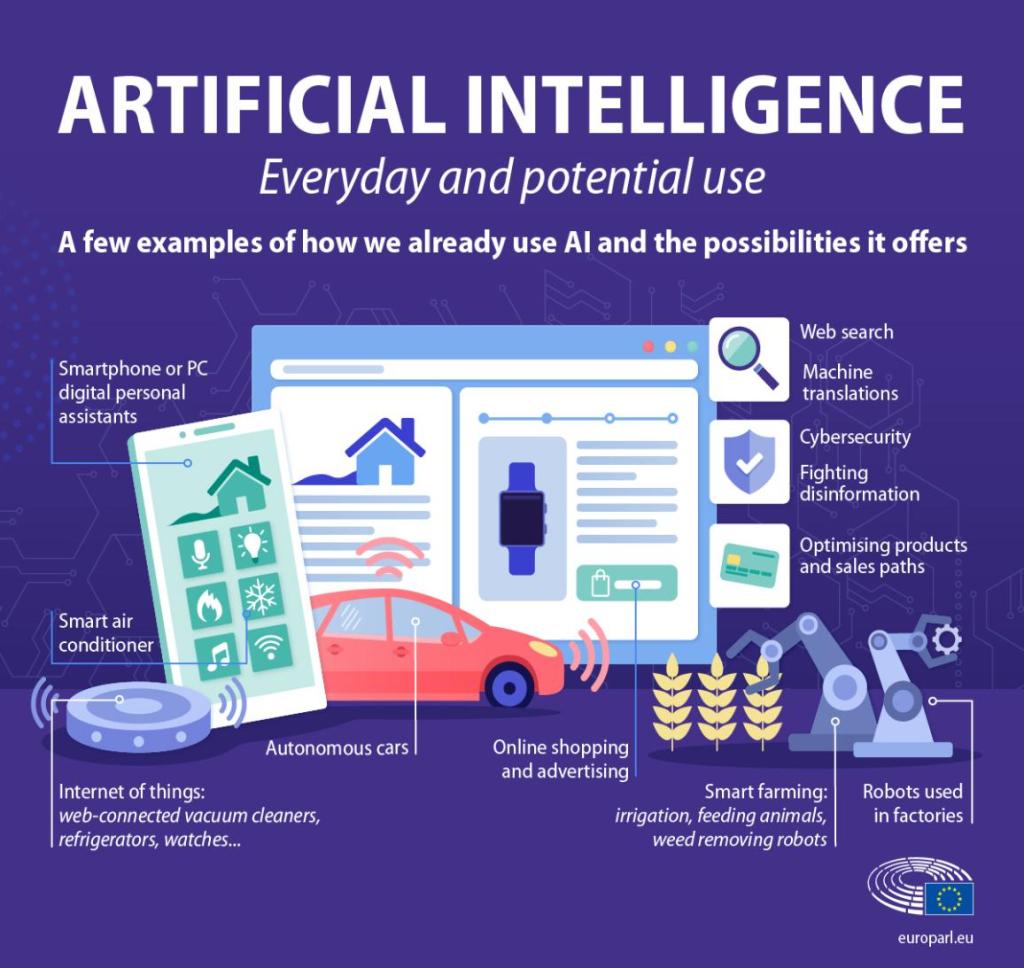
AI is the ability of a machine to display human-like capabilities such as reasoning, learning, planning and creativity.
AI enables technical systems to perceive their environment, deal with what they perceive, solve problems and act to achieve a specific goal. The computer receives data – already prepared or gathered through its own sensors such as a camera – processes it and responds.
AI systems are capable of adapting their behaviour to a certain degree by analysing the effects of previous actions and working autonomously.
The EU definition is pretty good outlining the human-like capabilities but references to a “computer” is slightly unusual as it’s likely to be from a computer, ecosystem or the internet. Also it’s questionable whether all AI is acting to achieve a specific goal – that is more similar to machine learning.
The 10 year old definition of AI
An AI system is a smart machine.
It gets information (input) and uses that to do things (actions) like creating stuff (text, images, video), giving advice or making choices.
These actions can change things in the real or digital world.
It may work on their own (or require humans).
It can learn from their experiences after they are set up.
Each AI system can do this differently.
There is no single definition of AI and this will continue to evolve (no doubt even the above examples from March 2024 will look dated soon).
Wrap Up
It’s important that you create a definition that suits your organisation as this is the foundation for an AI policy, principles or standard so your teams are clear on what is considered AI and what is not.
There are so many options to utilise AI and one of these is to help brainstorm a plan for when you start a new role. Here is a list of some cool ideas – just your role, responsibilities and industry to get personalised results that you can use, share and refine.
Within each section, there is detailed output of the prompts using Copilot for fictious examples. Just click on the heading and it will expand out.
Even as an experienced hire, it’s a good reminder to have those personal coaching checklists. Your key objectives will differ but putting these in can make sure you are considering you, the company and future success.
provide a ranked list of the top 10 things to do for personal development, integration into a new company and long term success in a new role
➥Example output: Ranked list of top 10 in a new role
Certainly! Here are the top 10 strategies for personal development, successful integration into a new company, and long-term success in a new role:
Set Clear Goals:
Define specific and actionable goals for your career and personal growth.
Measure your progress and adjust as needed.
Face Your Fears:
Embrace challenges that push you out of your comfort zone.
Overcome fears by taking calculated risks and seeking new experiences.
Read and Learn:
Read books, articles, and industry-related materials to expand your knowledge.
Attend webinars, workshops, and conferences to stay informed.
Seek New Opportunities:
Look for projects or tasks that challenge you and help you grow.
Volunteer for cross-functional teams or initiatives.
Build Relationships:
Network with colleagues, mentors, and industry professionals.
Cultivate strong professional relationships to learn and collaborate.
Receive Feedback:
Seek feedback from peers, managers, and mentors.
Use constructive criticism to improve and refine your skills.
Learn New Skills:
Take courses or workshops to acquire new skills.
Stay updated on industry trends and technological advancements.
Be Adaptable:
Embrace change and be open to learning.
Adapt to new processes, tools, and ways of working.
Practice Self-Reflection:
Regularly assess your progress and identify areas for improvement.
Understand your strengths and weaknesses.
Balance Work and Well-Being:
Prioritize self-care, physical health, and mental well-being.
Maintain a healthy work-life balance for sustained success.
Remember, personal development is an ongoing journey. Continuously invest in yourself, stay curious, and adapt to thrive in your new role! 🌟
30-60-90 day plan: your role
Sometimes a new role is like diving into the deep end. To stagger your onboarding, it’s often good to use a structure like a 30-60-90 day plan which allows a bit of flex but keep you accountable to making a difference in your first quarter and engaging with key colleagues.
create a detailed 30-60-90 day plan for an executive in the banking industry focussed on strategic projects and business value realisation. breakdown the key activities by week, outline the benefits and measurability.
➥Example output: 30-60-90 day plan, split by week
A 30-60-90 day plan for an executive in the banking industry should be well-structured, aligning with strategic goals, and focused on delivering tangible business value. Let’s break it down:
30-Day Plan
Week 1-2: Onboarding and Immersion
Activities:
Meet Stakeholders: Engage with key stakeholders, including department heads, team members, and cross-functional partners.
Understand Processes: Deep dive into existing processes, systems, and workflows.
Learn Culture: Familiarize yourself with the organizational culture and values.
Benefits:
Quick Integration: Establish rapport and build relationships.
Clarity: Gain insights into the current state of affairs.
Week 3-4: Project Assessment and Prioritization
Activities:
Project Inventory: Compile a list of ongoing and upcoming strategic projects.
Assess Impact: Evaluate each project’s potential impact on business growth and customer satisfaction.
Prioritize: Rank projects based on urgency, alignment with business goals, and resource availability.
Benefits:
Focused Efforts: Allocate resources effectively.
Strategic Alignment: Ensure projects contribute to overall business objectives.
60-Day Plan
Week 5-6: Project Execution Kickoff
Activities:
Project Teams: Assemble cross-functional teams for high-priority projects.
Set Milestones: Define specific milestones for each project.
Resource Allocation: Allocate budgets, technology, and personnel.
Benefits:
Acceleration: Projects move from planning to execution.
Visibility: Clear project timelines and responsibilities.
Week 7-8: Stakeholder Communication and Progress Tracking
Activities:
Regular Updates: Communicate project progress to stakeholders.
Risk Mitigation: Identify potential risks and develop mitigation strategies.
KPI Definition: Establish key performance indicators (KPIs) for each project.
Benefits:
Transparency: Stakeholders are informed and engaged.
Course Correction: Address issues promptly.
90-Day Plan
Week 9-10: Business Value Realization
Activities:
Monitor KPIs: Track project performance against KPIs.
Evaluate ROI: Assess return on investment for completed projects.
Customer Impact: Measure customer satisfaction and feedback.
Benefits:
Tangible Results: Demonstrate value delivered.
Learnings: Insights for future initiatives.
Week 11-12: Strategic Roadmap Refinement
Activities:
Lessons Learned: Gather feedback from project teams.
Adjust Strategies: Refine the strategic roadmap based on outcomes.
Long-Term Vision: Align short-term wins with long-term vision.
Benefits:
Continuous Improvement: Enhance processes and strategies.
Forward Momentum: Set the stage for ongoing success.
Remember, measurability is crucial. Regularly assess progress against predefined metrics and adjust the plan as needed. Good luck with your strategic endeavors! 🚀
Board Strategy: your outcomes
Often in a new Executive role, you will be asked to create or revise a Board strategy paper in your area of expertise. This may not happen initially but starts a good framing around the more strategic aspects of the role before you get stuck into the nitty gritty.
outline a board strategy like a mckinsey consultant would for strategic projects and business value realisation tabulating each section with key speaker notes
➥Example output: Board strategy tabulated with speaker notes
Certainly! Here’s an organized board strategy for strategic projects and business value realization, complete with key speaker notes:
Section
Objective
Activities
Benefits
Speaker Notes
1. Vision and Alignment
Ensure the board understands the organization’s long-term vision and strategic priorities.
– Conduct Strategic Alignment Workshops to align the board with the CEO’s vision. – Define KPIs linked to strategic goals.
– Unified Direction: Board members aligned on purpose. – Strategic Focus: Prioritize projects contributing to the vision.
“Ladies and gentlemen, our first priority is to align our strategic compass. Let’s engage in workshops to understand our long-term vision and establish clear KPIs.”
2. Portfolio Management and Resource Allocation
Optimize resource allocation across strategic projects.
– Review the Project Portfolio against strategic objectives. – Identify risks and dependencies. – Allocate budgets, talent, and technology.
– Efficiency: Allocate resources where they create the most value. – Risk Mitigation: Address bottlenecks early.
“Now, let’s delve into our project portfolio. We’ll assess risks, allocate resources wisely, and ensure alignment with our strategic goals.”
3. Value Realization Framework
Ensure projects deliver tangible business value.
– Understand value creation for each project. – Monitor execution against KPIs. – Quantify and communicate achieved value.
– Measurable Impact: Demonstrate ROI and outcomes. – Churn Prevention: Satisfied stakeholders stay engaged.
“Our next focus is value realization. We’ll track KPIs rigorously and communicate the impact we’re creating.”
4. Risk Oversight and Mitigation
Minimize risks associated with strategic projects.
“Risk management is critical. We’ll form committees, plan for scenarios, and ensure we’re prepared for any curveballs.”
5. Reporting and Accountability
Ensure transparency and accountability.
– Redesign board reports for strategic impact. – Regularly review project performance against KPIs. – Prepare for CEO succession.
– Informed Decisions: Real-time insights for the board. – Succession Readiness: Smooth leadership transitions.
“Lastly, let’s enhance our reporting, stay accountable, and be ready for leadership transitions. Transparency is key.”
Remember, our goal is to drive value creation and strategic impact. Let’s execute this plan with precision! 🚀
Boss: your performance expectations
Sometimes is good to understand what your boss might expect from you in terms of performance and how you would hope that they would support your onboarding. Always remember AI will give you the dream state so don’t be disappointed with the reality.
As a CEO outline how you would onboard and measure performance of an executive responsible for strategic projects and business value realisation
➥Example output: CEO onboarding and performance measures
Certainly! As a CEO, onboarding and measuring the performance of an executive responsible for strategic projects and business value realization are critical. Let’s break down the process:
Executive Onboarding
Orientation and Cultural Immersion:
Objective: Ensure the executive understands our company’s culture, values, and strategic direction.
Activities:
Welcome Meeting: Personally greet the executive and introduce them to the leadership team.
Company Overview: Provide an in-depth overview of our history, mission, and core values.
Meet Key Stakeholders: Arrange meetings with department heads, team members, and cross-functional partners.
Benefits:
Cultural Alignment: Set the tone for cultural integration.
Network Building: Establish relationships across the organization.
Strategic Deep Dive:
Objective: Equip the executive with insights into our strategic projects and business priorities.
Activities:
Project Portfolio Review: Discuss ongoing and upcoming strategic initiatives.
Business Context: Explain market dynamics, competitive landscape, and customer needs.
Alignment with Goals: Connect projects to our long-term vision.
Benefits:
Strategic Clarity: Ensure the executive understands our strategic imperatives.
Prioritization: Help them focus on high-impact projects.
Mentorship and Coaching:
Objective: Provide personalized guidance and support.
Activities:
Executive Mentor: Assign a seasoned leader as their mentor.
Regular Check-Ins: Schedule weekly or biweekly catch-up sessions.
Feedback Loop: Encourage open dialogue and address any challenges.
Benefits:
Accelerated Learning: Leverage the mentor’s experience.
Adaptation: Smooth transition into the role.
Performance Metrics and KPIs:
Objective: Define clear performance expectations.
Activities:
SMART Goals: Set Specific, Measurable, Achievable, Relevant, and Time-bound objectives.
Key Performance Indicators (KPIs): Identify metrics tied to project success.
Stakeholder Relationships: Gauge their ability to build strong partnerships.
Innovation and Adaptability: Assess their contribution to driving innovation.
360-Degree Feedback:
Peer Reviews: Gather input from colleagues and team members.
Direct Reports: Solicit feedback from those they lead.
Board Evaluation: Include board members’ perspectives.
Long-Term Impact:
Strategic Vision: Assess how their projects align with our long-term goals.
Organizational Culture: Observe their influence on company culture.
Succession Planning: Consider their potential for future leadership roles.
Remember, executive onboarding is an ongoing process. Regularly revisit goals, provide continuous feedback, and celebrate achievements. 🚀
KPIs: measuring results
KPIs (Key Performance Indicators) are key across most industries, organisations and teams. It’s good to understand what would be a good set of KPIs to assess against for the current KPIs in your new role.
create a KPI tree that would help measure success in a new role as an executive responsible for strategic projects and business value realisation
➥Example output: KPIs for key outcomes
Certainly! Here’s a KPI tree to measure success for an executive responsible for strategic projects and business value realization after 90 days:
Strategic Project Success:
1. Project Completion Rate:
Definition: Percentage of strategic projects completed within the planned timeframe.
Target: 90% or higher.
Measurement: Count of completed projects / Total planned projects.
2. Project ROI:
Definition: Return on investment for strategic projects.
Definition: Customer feedback and satisfaction scores.
Target: NPS score above industry average.
Measurement: NPS surveys, customer reviews.
4. Cost Savings:
Definition: Reduction in operational costs due to process improvements.
Target: 10% cost reduction.
Measurement: Actual cost savings.
5. Revenue Growth:
Definition: Increase in revenue attributable to strategic initiatives.
Target: 10% revenue growth.
Measurement: Actual revenue increase.
Leadership and Collaboration:
6. Cross-Functional Alignment:
Definition: Degree of alignment with other departments.
Target: High alignment.
Measurement: Feedback from cross-functional peers.
7. Team Engagement:
Definition: Employee engagement within the strategic projects team.
Target: 80% or higher engagement score.
Measurement: Employee surveys.
Remember, these KPIs will help you track progress, demonstrate value, and drive success in your new role. 🌟
Competitors: understand the market
It’s always important to get a high level snapshot of key competitors to then drilldown or formulate strategies.
outline a list of key competitors with the NZ banking industry, their market capitalisation, key strengths, weaknesses, opportunities and threats in a tabular format
➥Example output: Competitor size & SWOT
Certainly! Here’s a tabular outline of key competitors in the New Zealand banking industry, along with their market capitalization, strengths, weaknesses, opportunities, and threats:
Bank
Market Capitalization (NZD)
Strengths
Weaknesses
Opportunities
Threats
ANZ
High
– Established player with a wide customer base. – Strong international presence.
– Limited global reach. – Relatively smaller market share.
– Fintech partnerships. – ESG investments.
– Regulatory changes. – Interest rate volatility.
Westpac
High
– Diverse product portfolio. – Extensive branch network.
– Reputation challenges (recent scandals). – High operating costs.
– Investment in AI and data analytics. – SME lending growth.
– Regulatory scrutiny. – Economic shocks.
Remember, this analysis provides a snapshot, and each bank’s performance can change over time. 🏦
Press release: visualise the future
Amazon’s working backwards approach (writing a press release first) can help visualise for future success and also hone a winning outcome as a target, along with potential challenges that can be identified upfront and addressed.
write a working backwards (amazon method) news release for an executive (Tim Ely). He is responsible for strategic projects and business value realisation at Safe Bank. This is for a staff magazine and the story outlines a key success on customer personalisation leveraging AI.
➥Example output: Press release
News Release for Safe Bank
FOR IMMEDIATE RELEASE
Tim Ely Drives Personalization Revolution at Safe Bank: AI-Powered Customer Delight
SEATTLE, WA — Q3 2024 — Safe Bank, a trailblazer in financial services, proudly announces a transformative achievement led by Tim Ely, our esteemed Executive Vice President of Strategic Projects. Tim’s visionary leadership and relentless pursuit of excellence have reshaped how we serve our customers, setting a new industry standard for personalized banking experiences.
Key Success: AI-Powered Customer Personalization
In a rapidly evolving landscape, Tim Ely recognized that personalization is the cornerstone of exceptional customer journeys. Leveraging cutting-edge artificial intelligence (AI), the customer personalization initiative has achieved remarkable outcomes:
Hyper-Targeted Recommendations:
Our AI algorithms now analyze individual customer behavior, preferences, and transaction history.
Customers receive tailored product recommendations, from mortgage options to investment portfolios.
Result: A staggering 40% increase in cross-selling effectiveness.
Real-Time Fraud Prevention:
Tim’s team deployed AI models that detect anomalies and potential fraud in milliseconds.
Outcome: A 50% reduction in fraudulent activities.
Predictive Customer Service:
AI-driven chatbots anticipate customer inquiries and provide proactive solutions.
Customers receive personalized assistance, whether they’re applying for a loan or disputing a charge.
Impact: A 30% decrease in call center volume.
Dynamic Pricing Optimization:
Our AI dynamically adjusts interest rates, fees, and rewards based on individual profiles.
Customers benefit from fairer pricing, fostering loyalty and trust.
Achievement: A 15% increase in customer retention.
Quotes from Tim Ely
“Safe Bank’s commitment to customer-centric innovation drives our success. AI isn’t just a buzzword; it’s our compass for creating meaningful connections.”
“Collaboration across teams—data scientists, UX designers, and front-line staff—has been pivotal. Together, we’ve redefined banking.”
Celebrating Tim Ely’s Impact
Join us in celebrating Tim Ely’s extraordinary achievement. His legacy extends beyond metrics—it’s about empowering our customers’ financial dreams. Look out for the full feature in the upcoming Q3 2024 issue of Safe Bank’s staff magazine.
For media inquiries, please contact:
Safe Bank PR Team Email: pr@safebank.com Phone: (123) 456-7890
About Safe Bank: Safe Bank is committed to personalized banking experiences, where Tim Ely and our dedicated teams continue to innovate and elevate customer satisfaction worldwide.
Note: This news release is a fictional creation for illustrative purposes.
Hopefully this has given you some great examples to kickstart your new role and deliver as a well-structured and thoughtful newbie.
The positive power of Change Influencers can alter the dynamic to inspire innovation and change, rather than dread or manage it.
Change is an inevitable part of any organisation’s journey but can be the key blocker. It can be daunting, but with the right approach and people, it can also be an opportunity for growth and innovation.
One of the most effective strategies for navigating change is leveraging the influence of early adopters within the company. These change influencers are not just open to new ideas; they are the pioneers who lead by example and inspire others to follow suit.
The Catalysts of Change
Change influencers are typically those who possess a natural curiosity and a willingness to experiment. They are the first to explore new tools, processes, or behaviors that the company is looking to implement. Their enthusiasm and positive experiences can be contagious, helping to overcome the resistance that often accompanies change.
Building a Network of Pioneers
Creating a group of change influencers starts with identifying those who are most likely to embrace new challenges. These individuals often have a track record of adaptability and a reputation for being problem-solvers. Once identified, it’s crucial to empower them with the knowledge and resources they need to succeed.
The Ripple Effect
As change influencers start to adopt and advocate for new initiatives, their influence creates a ripple effect throughout the organization. Their success stories and practical advice become a source of motivation for others. They can demystify the change process, making it more approachable and less intimidating for their colleagues.
Sustaining Momentum
For change to take root, it’s essential to maintain momentum. Change influencers can play a pivotal role in this by providing ongoing support and encouragement. They can act as mentors, guiding their peers through the transition and helping to address any challenges that arise.
Conclusion
In the dynamic landscape of business, change influencers are invaluable assets. They are the early adopters who pave the way for others, turning potential adversity into a collective stride towards progress. By recognising and nurturing these individuals, companies can foster a culture that not only adapts to change but thrives on it.
Change influencers are the bridge between the present and the future of any organisation. By harnessing their potential, companies can ensure a smoother transition during times of change and set the stage for continued success.
The world of work stands at a critical juncture, where the convergence of technology and human ingenuity shapes our professional landscape. At this crossroads, Artificial Intelligence (AI) emerges as a transformative catalyst, reshaping industries, careers, and the very essence of employment. Let’s explore how AI navigates this transformative terrain in a couple of key areas.
Digital Fluency and AI Literacy
Empowering teams is critical for user and creators of AI alike.
Digital Upskilling: AI demands digital literacy. From data analysis to cybersecurity, proficiency in digital tools is essential for employability.
Human-AI Collaboration: Creativity flourishes as AI augments human capabilities. Writers, designers, and analysts collaborate with AI tools, creating content with lower skills. This potentially risks true creativity and a need for reshaping the borders of collaboration.
AI Literacy: Understanding AI’s impact is crucial. Organizations invest in AI education, ensuring informed decision-making, ethics, security, accountability and transparency.
Strategic disruption
AI-Driven Efficiency: Organisations will need to restructure to harness AI’s potential and stay cost competitive. From automating routine tasks to optimising supply chains, AI enhances operational efficiency and greater context than ever before.
AI-Driven Convergance: There is a risk of organisations relying heavily on vast knowledge in AI driven platforms to create strategies, incredibly similar to competitors, driving convergence rather than competition and differentiation.
AI and the Evolution of ‘Work’
Flexible Career Paths: Lifelong jobs could yield to more dynamic roles causing friction in employment. AI-driven automation creates new and fast changing opportunities, allowing people to pivot across industries and roles, without the need for years of accumulated knowledge.
Questions over Knowledge: The traditional focus on potential and knowledge gives way to skills around crafting questions and pverall design of automated processes. Companies seek candidates with proven abilities that can bridge the skills gap for their teams.
AI-Driven Talent Challenges: AI-powered platforms connect talent with opportunities matching skills to job requirements, streamlining recruitment. Candidates compete and use AI tools to refine CVs, job applications, photos and respond to contextual interview questions.
Wrap up
As we stand at this crossroads, AI beckons us toward a future where work transcends boundaries, different skills define success, and human-AI synergy could fuel or destroy innovation. The transformative force of AI is available for those who embrace its potential and navigate this dynamic landscape with foresight and adaptability. AI’s context is deeply reliant on big data, fueling its insights, ethics to apply it well and leaders driving its transformative power.
There are popular Prompting Patterns to follow based on the outcome you are trying to create. Regardless of your approach the following are considerations to help you get better results:
Clear: You write in common, simple language that’s easy to understand. Specific: It’s specific enough to provide direction. Sometimes include what you don’t want or an example to copy. Contextual: Provide enough context on your role, organisation and objectives to generate meaningful output. Relevant: Provide aspects relevant to the task for example how it will be used.
A prompt is an instruction that tells a large language model (LLM) to perform a task. The process is also known as instruction tuning. The model follows the prompt to determine the structure and content of the text it needs to generate.
Prompt engineering is the process of creating and refining the prompt that’s used by the model.
Prompt Structures
We’ve outlined our favourite options below which provide a great starting point. These help you complete a full prompt for the activity you are trying to complete with a better chance of success. Under each approach there is an example output to show you how much can be achieved.
T3 – Task, Tone and Target
Getting a task done in a tone you like with a target output in mind.
Task – What you need to get done
Tone – The style that you’d like used
Target – Describe the target output or audience
Example uses: Writing content, creating images, brainstorming
Create a logo for Data+AI that looks modern and professional to be used a new website.
Summarise this news article in a factual tone using 3-5 bullet points for an Executive audience.
Create a set of actions from meeting minutes in a succinct, action oriented tone tabulated in the following format: Action | Action Owner | Due Date
Example output – Meeting Actions
Action
Action Owner
Due Date
Review and finalize project budget
Project Manager
Feb 28, 2024
Conduct market research
Marketing Team
Mar 10, 2024
Draft initial proposal
Sales Team
Mar 5, 2024
Schedule client meeting
Account Manager
Mar 2, 2024
Update website content
Web Developer
Mar 8, 2024
Compile quarterly report
Finance Team
Mar 15, 2024
Coordinate logistics for event
Event Coordinator
Mar 12, 2024
Follow up with potential partners
Business Development Team
Mar 7, 2024
Prepare presentation materials
Marketing Team
Mar 10, 2024
Conduct employee training session
HR Manager
Mar 6, 2024
STAR – Situation, Task, Action, Result
Describe the situation, outline the task, detail action taken, and share the result.
Situation – The context of your role and organisation
Task – The details that you want to be completed (e.g. a plan)
Action – Describe the actions that are required supporting the task
Result – The final result being specific on measures, formats and additional information (e.g. totals)
Example uses: Planning, complex tasks
I’m a Programme Director in a Bank and need a series of detailed tasks for a new communication tool implementation. For each step the likely resources in a format to be shared with delivery partners. Provide an effort estimate (in weeks) for each resource and task. Tabulate the results as Phase, Task, Resource, Effort. Create another table with the totals by Resource.
Example output – Programme Estimate
Below are the detailed tasks for a new communication tool implementation in a bank, along with likely resources and effort estimates, tabulated by phase:
Phase
Task
Resource
Effort (in weeks)
Project Initiation
Define project scope, objectives, and success criteria
Project Manager
2
Business Analysts
3
Stakeholders
2
Conduct feasibility study and risk assessment
Business Analysts
3
Subject Matter Experts
2
Develop project plan including timelines and resource allocation
Project Manager
2
PMO Support
2
Requirements Gathering
Identify communication needs and user requirements
Business Analysts
3
IT Specialists
2
End-users
3
Conduct stakeholder interviews and workshops
Business Analysts
3
Project Manager
2
Stakeholders
3
Vendor Selection
Research and shortlist communication tool vendors
Procurement Team
3
IT Specialists
2
Business Analysts
2
Evaluate vendor proposals and conduct demonstrations
Procurement Team
3
IT Specialists
2
Business Analysts
2
Negotiate contracts and finalize vendor selection
Legal Team
3
Procurement Team
2
Finance
2
System Configuration
Install and configure the communication tool
IT Specialists
3
System Administrators
2
Customize the tool to align with bank-specific requirements
IT Specialists
3
System Administrators
2
Business Analysts
2
Integrate the tool with existing systems
IT Specialists
3
System Integrators
2
Testing and QA
Develop test cases and scenarios
QA Specialists
3
Business Analysts
2
End-users
2
Conduct functional, integration, and user acceptance testing
QA Specialists
3
End-users
2
IT Specialists
2
Identify and resolve any issues or bugs
Development Team
Ongoing
IT Specialists
Ongoing
Training and Documentation
Develop training materials and user guides
Training Specialists
3
Technical Writers
2
Conduct training sessions for end-users and administrators
Training Specialists
2
Subject Matter Experts
1
Create support documentation and FAQs
Technical Writers
2
Subject Matter Experts
1
Deployment and Rollout
Plan and coordinate the deployment schedule
Project Manager
2
Deployment Team
2
Execute the deployment of the communication tool
IT Specialists
2
Deployment Team
2
Monitor deployment progress and address any issues
Project Manager
Ongoing
Deployment Team
Ongoing
Post-Implementation Review
Evaluate the success of the implementation
Project Manager
2
Stakeholders
2
Gather feedback from end-users and stakeholders
Project Manager
2
Business Analysts
2
Identify lessons learned and areas for improvement
Project Manager
2
Team Members
2
Ongoing Support and Maintenance
Establish a support mechanism for end-users
Helpdesk Support
Ongoing
IT Specialists
Ongoing
Monitor system performance and address any maintenance needs
IT Specialists
Ongoing
System Administrators
Ongoing
Implement updates and upgrades as necessary
IT Specialists
Ongoing
System Administrators
Ongoing
Vendor Support
Ongoing
Change Management and Communication
Develop a change management plan
Change Management Specialists
3
Project Manager
2
Communicate changes to stakeholders and end-users
Communication Specialists
Ongoing
Project Manager
Ongoing
Now, let’s create another table to summarize the total effort by resource:
Resource
Total Effort (in weeks)
Project Manager
27
Business Analysts
23
Stakeholders
7
Subject Matter Experts
7
PMO Support
2
IT Specialists
40
Procurement Team
8
Legal Team
3
Finance
2
System Administrators
12
System Integrators
2
QA Specialists
6
Development Team
Ongoing
Training Specialists
7
Technical Writers
4
Deployment Team
10
Team Members
2
Helpdesk Support
Ongoing
Change Management Specialists
3
Communication Specialists
Ongoing
Vendor Support
Ongoing
This table gives an overview of the total effort required by each resource throughout the implementation process.
CLEAR – Challenge, Limitation, Effect, Action, Result
Identify a challenge, acknowledge a limitation, predict the anticipated effect, propose an action plan, and expected results.
Challenge – The problem you are trying to solve
Limitation – The restrictions that you have
Effect – Describe the expected impacts from you challenge
Result – The final result being specific on expected outputs, formats, audiences and additional information (e.g. totals, recommendations)
Example uses: Crisis communication, project risks.
We have a security breach of our IT systems and do not have a clear timeframe for resolution and expect significant customer loss but we need clear actions to reassure our stakeholders as a professional board paper.
Our Marketing department experiences a mass exodus of highly skilled employees, due to a competitive job market, dissatisfaction with company policies and changes in leadership. This sudden loss of talent threatens to disrupt critical projects and decrease productivity and competitive disadvantage. The board paper should outline strategies for talent retention, recruitment, and knowledge transfer to mitigate the impact.
Our insurance company fails to meet new regulatory requirements imposed by a government agency, resulting in fines, legal action, and potential suspension of operations. This compliance failure stems from inadequate internal controls, outdated processes, and misunderstanding of regulatory obligations. The board must develop a remediation plan to address the compliance deficiencies, allocate resources for corrective actions, and establish protocols to prevent future regulatory lapses to operate responsibly within the regulatory framework.
Example Output – IT security incident
Title: Response Plan for IT Security Breach
Objective: To outline clear actions to address the ongoing IT security breach and reassure stakeholders of our commitment to resolution and mitigation.
Background: We acknowledge the severity of the current IT security breach and its potential impact on our organization, including significant customer loss. The breach demands immediate attention and a robust response strategy to mitigate damages and restore trust.
Current Status:
The breach has been identified, and investigation procedures are underway to determine the extent of the intrusion.
Efforts are being made to contain the breach and prevent further unauthorized access to sensitive data.
The timeframe for resolution remains uncertain, as it depends on the complexity and scope of the breach.
Proposed Actions:
Transparent Communication: Establish a clear communication protocol to keep stakeholders informed about the situation, including regular updates on the progress of investigations and mitigation efforts. Transparency is key to maintaining trust and credibility.
Engage Security Experts: Collaborate with external cybersecurity experts to conduct a comprehensive assessment of our systems, identify vulnerabilities, and recommend measures to strengthen our defenses against future attacks.
Data Protection Measures: Implement enhanced security measures to safeguard sensitive data, such as encryption protocols, access controls, and regular data backups. Prioritize the protection of customer information to mitigate potential losses and comply with regulatory requirements.
Customer Outreach: Proactively reach out to affected customers to provide assurance, guidance, and support in case of any compromised information. Offer solutions, such as credit monitoring services or identity theft protection, to mitigate the impact on their privacy and financial security.
Internal Review and Training: Conduct an internal review of our IT protocols and employee training programs to identify areas for improvement in cybersecurity awareness and incident response readiness. Invest in ongoing education and training initiatives to empower employees with the knowledge and skills to recognize and respond effectively to security threats.
Regulatory Compliance: Ensure compliance with relevant data protection regulations and industry standards to avoid potential legal repercussions and maintain the trust of our stakeholders.
Conclusion: In conclusion, while the IT security breach poses significant challenges and uncertainties, we are committed to taking proactive measures to address the situation, mitigate damages, and rebuild trust with our stakeholders. By prioritizing transparency, collaboration, and continuous improvement, we will emerge stronger and more resilient in the face of future cybersecurity threats.
Recommendation: The board is recommended to approve the proposed actions outlined in this paper and provide necessary resources and support to expedite the resolution process and minimize the impact of the security breach on our organization and stakeholders.
AIDA – Attention, Interest, Desire, Action
Capture an audience’s attention, maintain their interest, create desire for the product or service, and prompt action.
Attention – What is the key campaign or way of grabbing prospective or existing customer’s attention
Interest – What is the parts of this that would interest a prospective customer
Desire – How do you build desire within your prospective customers
Action – What is the action you plan as an outcome of a successful campaign
Exampleuses: Marketing to create engaging content that grabs attention and drives sales.
Create a campaign for Electric Vehicle (EV) cars generating excitement among potential buyers. The car has superior performance over traditional combustion-engine vehicles. Modern interiors, lower weekly costs of transport and aerodynamic exteriors mean people will want to watch videos by celebrities to build anticipation and desire and then test drive these cars for themselves. A seamless online ordering process with transparent pricing and financing options, coupled with limited-time incentives such as rebates or free charging station installation for early adopters to buy our EV car.
Create a marketing campaign to utilise the Attention, Interest, Desire, Action (AIDA) model to promote a new fitness app looking for trial users
Example Output – New Fitness App
Attention: Banner Ad:
Eye-catching image of a person smiling while using the app.
Bold text: “Transform Your Body in Just 30 Days!”
Subtext: “Discover the Ultimate Fitness App Loved by Thousands!”
Interest: Video Ad:
Scene 1: A person struggling with traditional workouts.
Scene 2: Introduce the app interface, showcasing personalized workout plans.
Scene 3: Show various workouts available in the app, including yoga, HIIT, and strength training.
Scene 4: Highlight progress tracking feature and motivational messages.
Voiceover: “Tired of boring workouts? Try our app! Personalized plans, diverse workouts, and progress tracking all in one place!”
Desire: Social Proof:
Testimonial from a satisfied user: “I never thought I could enjoy working out until I found this app! It’s like having a personal trainer in my pocket!”
Before-and-after photos of users who achieved remarkable results using the app.
“Join thousands of users who’ve transformed their bodies and lives with our app!”
Action: Call-to-Action:
Website: “Start Your 30-Day Free Trial Now!”
App Store Buttons: “Download Now and Begin Your Fitness Journey!”
Limited-time Offer: “Get Access to Premium Features Free for the First Month!”
Email Campaign:
Subject Line: “Ready for a Change? Try Our Fitness App FREE for 30 Days!”
Content: Highlight app features, success stories, and the limited-time offer. Encourage recipients to click the link to download the app and start their trial.
By incorporating attention-grabbing visuals, showcasing the app’s features to generate interest, leveraging social proof to create desire, and providing clear calls-to-action, this marketing campaign aims to effectively promote the new fitness app and attract trial users using the AIDA model.
Potential Tones
Tones or styles help refine the output.
Blog Post: Informative, Humorous, Advisor, Formal, Informal
If you know a particular person or company, you can also reference in the style of [person, company].
If you want to assess your own style, use this prompt:
Provide the tone and style of this text: [copy in recent text you’ve created]
Example output – tone & style
The tone of the text is informative and optimistic. The language used is professional and confident, presenting facts and statistics to support the claims made. Overall, the style is authoritative and forward-thinking, aiming to persuade readers of the significance of the potential.
This can then be turned into a prompt:
Create 5 paragraphs about public speaking using the following style: The tone of the text is informative and optimistic. The language used is professional and confident, presenting facts and statistics to support the claims made. Overall, the style is authoritative and forward-thinking, aiming to persuade readers of the significance of the potential.
Output Types
Tabulate
Use the format: A, B, C
Bullet point
Limit to 5 paragraphs
Use APA (American Psychological Association) references
Hopefully these tips, tricks and examples help you to create some great prompts.
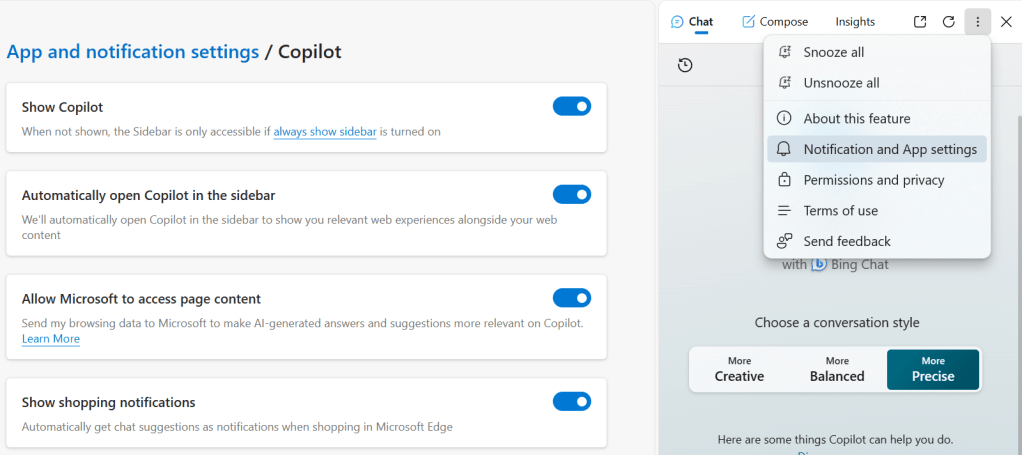
Copilot in Bing Chat can enable ready access to AI with a balance between current information (Bing) and the power of LLMs (via OpenAI). For Enterprise users, this can be enabled with controls in place.
Within Edge, by default Copilot doesn’t have access to the page content. You can enable this under “Notification and App settings” within Microsoft Edge.
AI is no longer a futuristic concept; it’s transforming the way businesses operate and can be a huge advantage to drive collaboration and leverage vast knowledge within a company. Let’s delve into how AI can foster collaboration and a five-step plan to achieve it.
The Benefit of AI in Collaboration
AI can play a pivotal role in fostering collaboration in several ways:
Improved Communication: AI-powered chatbots can facilitate seamless communication, ensuring that no message or request goes unnoticed. They can handle routine queries, freeing up team members for more complex or personal tasks.
Project Management: AI can help manage projects more efficiently by summarising key meetings & decisions, predicting potential roadblocks, optimising resource plans, and keeping all team members updated about project progress.
Data Analysis: AI can analyse vast amounts of data to provide insights that can be used for strategic decision-making. These insights can be shared across teams, promoting data-driven collaboration leveraging broader datasets than may be manually selected.
Personalised Learning: AI can provide personalised learning experiences, helping employees improve their skills and knowledge in areas that are most relevant to their roles. It may also be able to leverage a combination of policies, learning materials and current discussions.
Innovation: By automating routine tasks, AI allows employees to focus on creative and innovative aspects of their work, fostering a culture of innovation across teams.
A plan to foster collaboration leveraging AI
Here’s a five-step plan to leverage AI for enhancing collaboration:
Identify the Needs: The first step is to identify the areas where AI can enhance collaboration. This could be communication, project management, data analysis, learning, or innovation.
Choose the Tool: Once the needs are identified, choose the right AI tools that meet these needs. There are numerous AI tools available in the market, each with its unique features and benefits.
Train & engage the Team: Implementing AI tools is not enough; employees need to be trained to use these tools effectively. Provide adequate training and support to ensure smooth adoption.
Monitor and adjust: Monitor the effectiveness of the AI tools and make necessary adjustments. Remember, implementing AI is not a one-time task but an ongoing process that requires continuous monitoring and improvement.
Promote a Culture of Collaboration: Last but not least, promote a culture of collaboration. Encourage employees to use AI tools for collaborative tasks and recognize their efforts.
In conclusion, AI has immense potential to enhance collaboration within a corporate environment. However, it requires careful planning and execution. With the right approach, businesses can leverage AI to foster a collaborative culture that drives innovation and growth.










 Data + AI
You must be logged in to post a comment.